The images below are 2-D but yet they all appear to be moving. As our brain perceives the images it sends signals that the object is moving even though we know it is a still picture.
Tuesday, November 1, 2016
Zach- Visual Illusions
Visual Illusions result from a misinterpretation of visual stimulants which takes place as a result of either a pathological condition or a misperception of the stimulants. Simply put, what we see does not fit the properties of the object we are viewing.
The images below are 2-D but yet they all appear to be moving. As our brain perceives the images it sends signals that the object is moving even though we know it is a still picture.


The images below are 2-D but yet they all appear to be moving. As our brain perceives the images it sends signals that the object is moving even though we know it is a still picture.
Zach- Figure-Ground Perception
Figure-Ground perception is when we perceive an image, we tend to simplify it by separating it into figure and ground. The figure is the object you perceive. The ground is everything in the background. This is what causes people to see variations in black and white images. Depending on which your brain depicts as the ground or figure will determine what you see in the image.
The image below will either be a vase looking object or two faces looking into each other, depending upon how your brain sorts the black or white.
Zach-Proximity
The tendency of objects to be associated more strongly with nearby objects than with those that are farther away. We automatically group similar items by position, by color, or by shape. This process of grouping can help us determine the meaning of the image.
The image below is just triangles assembled randomly, but our brain is able to use proximity to group these shapes together allowing us to see the Statue of Liberty.

The image below is just triangles assembled randomly, but our brain is able to use proximity to group these shapes together allowing us to see the Statue of Liberty.
Binocular cues Katie
Retinal disparity: When your retinas receive different images and when put together, you can percieve distance. For example, when looking cross-eye at your nose, you see that it is very close to your eyes. Then, when looking at your feet, you see that they are much more far away.
Convergence: The idea that the more the eyes converge inward, the closer the object to you. In this photo, for example, your eyes see the blue sphere as the closest because the rest of the picture causes your eyes too converge inward and focus on it.
Brightness Constancy
Brightness Constancy is how we perceive an object as having a constant lightness even while its illumination may change. The light that we perceive also depends on relative luminance which is the amount of light an object reflects relative to its surroundings. For example when the sun shines on the flowers we still see it as the same color as when there is no light shining on them.
https://encrypted-tbn1.gstatic.com/images?q=tbn:ANd9GcQ40fgXuC2FMXbEHn30eQB8-hTmJM6DgiEKDbq1KPM2ZkRwRMAG
Monocular Cues (cont.) Katie
-Interposition: When one object blocks out the view of another, we think that object is closer. For example, we see in this photo that the green triangle is the farthest away and the yellow circle is the closest. We perceive it this way because of how the shapes overlap.
-Linear perspective: When parallel lines cover more of an area, they are far away. In the photo below, you can see the depth perception of the bridge because of how the lines are more condensed in the center of the photo. This makes us see the depth in the picture.
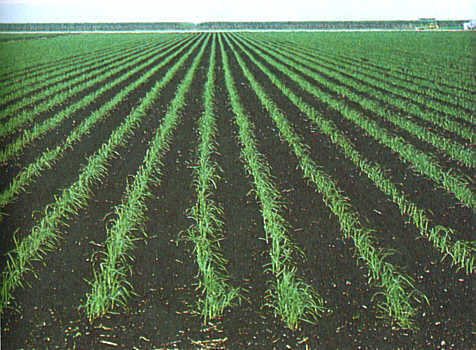
-Texture gradient:When the texture of an object changes, our perception of how far away it is changes. For example, in the photo below, the more widely spaced rows make us see that they are close. The more densely packed rows make us see that they are farther away.
field1.jpg-Linear perspective: When parallel lines cover more of an area, they are far away. In the photo below, you can see the depth perception of the bridge because of how the lines are more condensed in the center of the photo. This makes us see the depth in the picture.
Size constancy
Size constancy is how we perceive objects as having a constant size, even when we increase or decrease how far away we are from them. An example of this would be of this picture where the boy appears a lot smaller than the man that is closer up. Your brain however knows that the boy is much bigger than he appears because we perceive him as having a constant size.
http://farm5.static.flickr.com/4154/4831420198_0312c079b2.jpg
Monocular Cues
-Relative size: When we assume that one of two objects is smaller in size, it must be because it is farther away than the other. We see this in drawings that are 2 dimensional. We think that one object is farther back in the drawing than the other because it is drawn smaller. For example, the cow in the photo below is farther back than Donald Duck because he is drawn smaller.
36194219-cartoon-pics.jpeg
-Relative motion: When you are in motion and looking at an object, you seem to move faster as the objects get larger and closer to you.
-Relative height: When we see two objects and one is higher than the other, we perceive the higher object to be farther away. For example, we see this when looking across a room and seeing a table in the center of the room and a painting on the far wall. The painting on the wall is seen as farther away than the table because the painting is higher in our field of vision.
-Relative clarity: When we see foggy or blurry objects to be farther away than clear or sharp objects. We think the blurred object is farther away because our eyes like to focus on the clear objects in the foreground and we perceive them as closer to us. For example, in portraits, when the background is blurred, we perceive the person in the photo to be closer to us because they are the focus of the picture.
36194219-cartoon-pics.jpeg
-Relative motion: When you are in motion and looking at an object, you seem to move faster as the objects get larger and closer to you.
-Relative height: When we see two objects and one is higher than the other, we perceive the higher object to be farther away. For example, we see this when looking across a room and seeing a table in the center of the room and a painting on the far wall. The painting on the wall is seen as farther away than the table because the painting is higher in our field of vision.
-Relative clarity: When we see foggy or blurry objects to be farther away than clear or sharp objects. We think the blurred object is farther away because our eyes like to focus on the clear objects in the foreground and we perceive them as closer to us. For example, in portraits, when the background is blurred, we perceive the person in the photo to be closer to us because they are the focus of the picture.
Shape constancy
Shape Constancy is how we perceive the form of familiar objects as constant even when the angle of the image changes. For example when we look at a plate from any angle we know that it is a circle. However a plate is only a circle if you look at it head on. From any other angle it starts to form an ellipse.


https://ep002.files.wordpress.com/2014/02/plate-1.jpg
https://ep002.files.wordpress.com/2014/02/plate-2.jpg


https://ep002.files.wordpress.com/2014/02/plate-1.jpg
https://ep002.files.wordpress.com/2014/02/plate-2.jpg
Lauren- Law of Continuity
The Law of Continuity
states that points that are connected by straight or curving lines are seen in
a way that follows the smoothest path. Rather than seeing separate lines and
angles, lines are seen as belonging together. For example, continuation occurs in the picture below, because the viewer's eye will naturally follow
a line or curve. The
smooth flowing crossbar of the "H" leads the eye directly to the
maple leaf.
http://graphicdesign.spokanefalls.edu/tutorials/process/gestaltprinciples/gestaltprinc.htm
Lauren- Law of Similarity
The law of similarity
is a Gestalt principle of organization holding that parts of a stimulus field
that are similar to each other tend to be perceived as belonging together as a
unit. This is in an assumption that all other aspects related to the stimuli
are equal. We tend to group things together based on their similar
aspects. For example, in the picture
below, many people see vertical columns of triangles and circles because they
group the similar shapes together. Another example of this would be grouping
laundry together based upon color.

https://www.crafthubs.com/sorting-laundry/21262
Lauren- Law of Closure
The Law of Closure is a Gestalt principle of
organization holding that there is an innate tendency to perceive incomplete
objects as complete and to close or fill gaps and to perceive asymmetric
stimuli as symmetric. An example of this would be if a circle was drawn using broken lines. It would still perceived by the
brain as a circle. Through this example, you can infer the brain's tendency to
ignore the gaps and see the figure as a circle.
Reversible Figures
A reversible figure is a generalized image that can be interpreted from different perspectives as two distinct images. Two people can look at the same picture and perceive completely different things. For example, I see both a duck and rabbit when I look at this image from different perspectives.
https://psychlopedia.wikispaces.com/Ambigous+Figures
Subscribe to:
Comments (Atom)